Best Books on AI History
AI history stops being a list of dates once you can trace ideas across founders, funding cycles, and technical breakthroughs: start with Stuart Russell and Peter Norvig’s Artificial Intelligence for the big map, then deepen with Nilsson and McCorduck’s timelines.
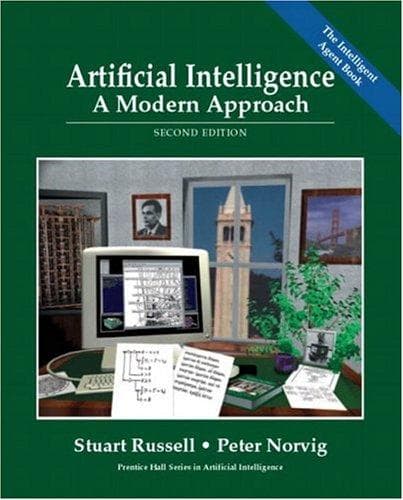
Artificial Intelligence
Stuart J. Russell, Peter Norvig
Finishing Artificial Intelligence leaves you seeing today’s AI as a stack of assumptions, not a single invention: search, logic, learning, and uncertainty connected by one unifying aim.
Treat AI as “rational agents under uncertainty.”
It frames AI subfields with a historical sense of why each approach rose and what it still cannot guarantee. That matters for AI history because it teaches you to judge claims by formal goals and trade-offs, not hype.
The Master Algorithm
Pedro Domingos
Domingos pushes you to see AI history as a competition of five families trying to explain learning with one unifying story.
The “five tribes” compete to unify learning.
Instead of treating history as a timeline of unrelated techniques, it links major machine learning traditions to a single question: what general method should master future prediction. That viewpoint makes the evolution of AI feel intellectually connected.
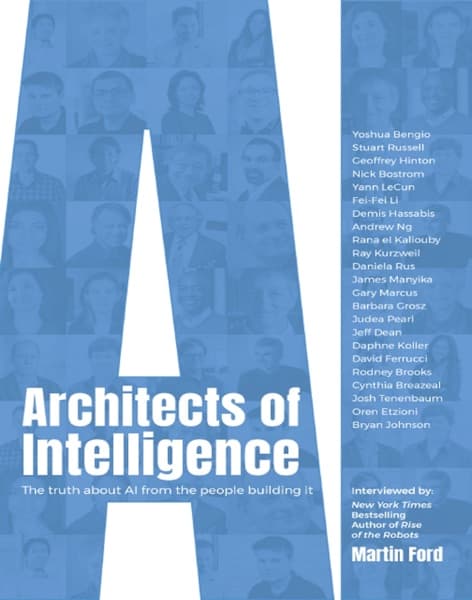
Architects of Intelligence
Martin Ford
Architects of Intelligence leaves you with a researcher’s map of milestones, controversies, and near-term realities shaping what AI will actually do next.
Expect impacts before you expect inevitability.
It uses leading voices to connect the dots between breakthroughs and the forces around them. That helps with AI history because it adds interpretation, not just events.
Genius Makers
Cade Metz
Genius Makers makes modern AI history feel like a series of engineering bets where data, compute, and people collided to produce sudden capability jumps.
Compute plus data turned ideas into systems.
Metz’s reporting spotlights the individuals and decisions behind today’s breakthroughs, giving you a felt sense of how progress really happened. That makes AI history more than theory and more than marketing.
The Infinity Machine
Sebastian Mallaby
The Infinity Machine pulls back the curtain on Demis Hassabis and Google DeepMind, showing how a British chess prodigy built the research engine driving today's AI revolution.
True progress came from combining neuroscientific intuition with massive compute, not raw scale alone.
It grounds the AI boom in the specific culture, rivalries, and breakthroughs of DeepMind rather than Silicon Valley hype. Sebastian Mallaby’s deep access highlights the tension between pure scientific ambition and the escalating arms race for talent and compute.
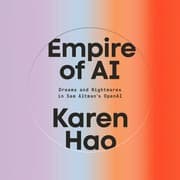
Empire of AI
Karen Hao
Empire of AI exposes the hidden human and environmental cost behind the artificial intelligence boom, tracing how tech giants extract labor, data, and natural resources to power modern algorithms.
Artificial intelligence relies on a vast, unseen working class to clean data and train models, making tech progress deeply dependent on human exploitation.
It shifts the focus away from algorithm design and executive boardrooms to reveal AI as an extractive global industry. Karen Hao’s investigative reporting connects data labeling sweatshops, massive energy demands, and resource exploitation to show who really pays the price for technological speed.
Can we tailor this list for you?
Type your question in the bar below and the AI will tailor a fresh set of picks just for you.