Books Like Enshittification by Cory Doctorow
Cory Doctorow gave a name to the decay everyone felt but could not label: the slow rot of platforms that once served users and now mostly extract from them. These books trace the same arc from other angles, monopoly power, surveillance, the privatized internet, and the organized fight to win it back.
The Age of Surveillance Capitalism
Shoshana Zuboff
The defining account of how your behavior became raw material.
Surveillance capitalism does not just watch you, it funds a futures market in predictions about your next action, sold to whoever will pay to shape it.
Zuboff shows how Google and Facebook turned ordinary human experience into behavioral data sold to predict and nudge what you do next, which is the economic engine running underneath the decay Doctorow describes.
The Master Switch
Tim Wu
Every open information empire eventually closes. History says so.
Wu's Cycle predicts that an open network is always destined to be captured unless someone deliberately keeps the switch open.
Wu traces the telephone, radio, film, and cable through a recurring cycle from scrappy openness to captured monopoly, the long pattern that makes enshittification feel less like a new disease than an old one.
The Internet Con
Cory Doctorow
Doctorow's blueprint for prying open the walled gardens.
Lock-in, not network effects, is what really traps you; force interoperability and the switching cost that protects a bad platform simply vanishes.
This is his direct companion to Enshittification, making the case that mandatory interoperability, letting you leave a platform without losing your friends and files, is the single lever that disciplines Big Tech.
Chokepoint Capitalism
Cory Doctorow, Rebecca Giblin
How monopolies choke the money before it reaches the people who made the work.
A market with a single buyer, a monopsony, is as dangerous as one with a single seller; both let a middleman set the price and keep the surplus.
Giblin and Doctorow map the exact chokepoints, Amazon, Spotify, Google, that capture creative markets, then devote the back half of the book to concrete remedies instead of leaving you with only the diagnosis.

Goliath
Matt Stoller
A century of fighting monopolies, and of forgetting how.
Monopoly was once treated as a threat to democracy itself, not merely a question of consumer prices; that quiet reframing is why Big Tech grew unchecked.
Stoller recovers the lost American tradition of anti-monopoly politics, explaining how concentration crept back into tech after decades in which antitrust enforcement was deliberately defanged.
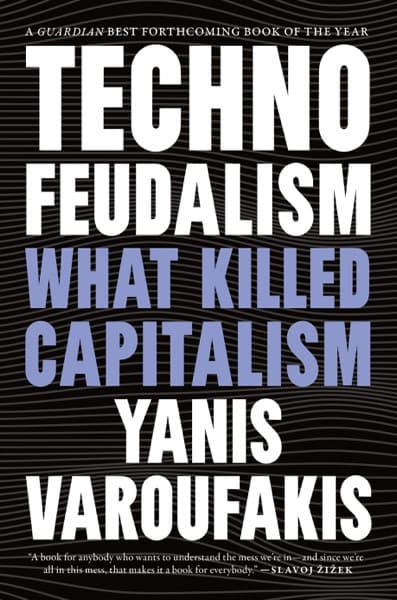
Technofeudalism
Yanis Varoufakis
What if the platforms are not capitalism but something older and worse?
When you pay a platform to reach customers you already have, you are paying cloud rent to a landlord, not buying a service from a rival.
Varoufakis argues that cloud platforms extract rent like feudal landlords rather than compete like firms, a provocative frame for the value clawback stage that Doctorow puts at the end of the decay.
Wu's Cycle predicts that an open network is always destined to be captured unless someone deliberately keeps the switch open.

Who Owns the Future?
Jaron Lanier
The networks that promised to enrich everyone concentrated the wealth instead.
When a service is free, the real product is the data you supply, and the value of that data flows to whoever owns the largest server.
Lanier, a Silicon Valley insider, shows how the biggest computer on a network quietly siphons value from everyone who feeds it data, a pattern he named years before it became obvious to the rest of us.
Careless People
Sarah Wynn-Williams
An insider's view of how corporate culture inside Big Tech prioritized growth over safety and accountability.
When rapid growth becomes the sole internal metric of success, ethical concerns and long-term societal consequences are consistently treated as minor speed bumps rather than red flags.
Written by a former tech executive, Wynn-Williams offers a rare, first-hand look at the internal decisions and reckless pursuit of expansion that laid the groundwork for platform decay and systemic failure from the inside out.
Can we tailor this list for you?
Type your question in the bar below and the AI will tailor a fresh set of picks just for you.