Best Books on the History of the Internet
The internet arrived so completely it now feels like weather, always there, rarely explained. These books explain it: the experiment that linked a few universities, the gold rush that made it a shopping mall, and the slow rot Cory Doctorow named enshittification. Half origin story, half reckoning with what it became.
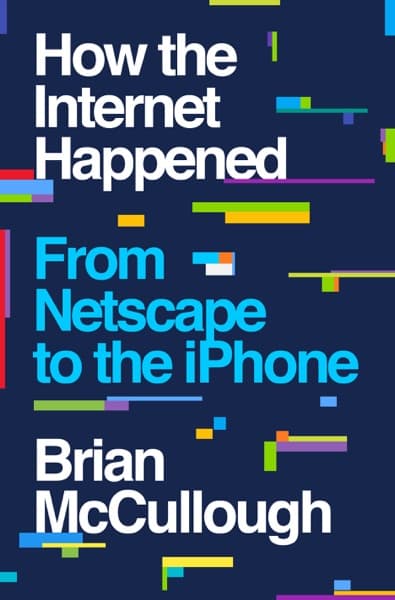
How the Internet happened
Brian McCullough
The commercial web's rise, from Netscape's IPO to the iPhone.
The modern internet was not planned; it was a series of gambles that happened to compound into a new economy.
It picks up where the invention stories end and narrates the internet most people actually lived through, the browser wars, the dot-com bubble, Google, Facebook, and the smartphone, with the pace and detail of someone who ran a tech podcast on exactly this.
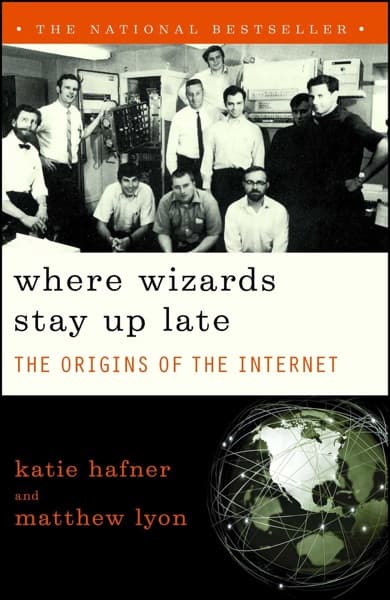
Where Wizards Stay Up Late
Matthew Lyon, Katie Hafner
The origin story of ARPANET, the network that became the internet.
The internet began as a way to share scarce computers, and its defining habits, like email, were unplanned side effects.
It reconstructs how a small band of researchers and engineers built packet switching and the first node-to-node links in the late 1960s, capturing the improvisation and personalities behind protocols we now take completely for granted.
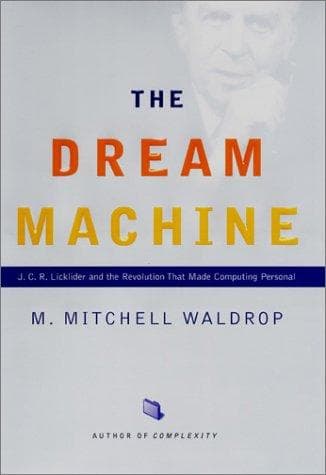
The Dream Machine
M. Mitchell Waldrop
How J.C.R. Licklider imagined interactive computing decades early.
Most breakthroughs credited to the 1990s were dreamed, and funded, in the 1960s by people few users could name.
It centers the visionary who funded and inspired much of the research that led to personal computing and networks, showing that the internet's deepest roots lie in one man's conviction that computers should augment human thought.
Broad Band
Claire L. Evans
The women who built the internet, written back into the story.
The social internet, forums and communities, was largely a women's invention, long before it was called social media.
It recovers the programmers, hypertext pioneers, and community builders, from Ada Lovelace to the founders of early online networks, who shaped computing and the web but got edited out of the standard great-men narrative.
Tubes
Andrew Blum
A field trip to the internet's actual physical body.
The internet is a real place made of concrete and glass fiber, and surprisingly much of it runs through a few unremarkable buildings.
It chases the cloud back down to earth, the data centers, undersea cables, and unmarked buildings where networks physically meet, puncturing the myth that the internet is weightless and everywhere at once.
The Master Switch
Tim Wu
The recurring cycle from open frontier to closed empire.
Open networks tend to be captured; the question is never if consolidation comes, but who ends up holding the master switch.
It reads the internet against the histories of telephone, radio, and film, arguing that every information technology swings from wild openness to consolidated control, which reframes today's platform giants as a pattern, not an accident.
The internet began as a way to share scarce computers, and its defining habits, like email, were unplanned side effects.

Enshittification
Cory Doctorow
A precise theory of how good platforms rot.
Platforms decay in a predictable order: good to users, then good to business, then good only to shareholders.
It names the three-stage decay of digital platforms and traces how lock-in, monopoly, and the death of interoperability let companies degrade the exact services that made them essential, then argues concretely for what could reverse it.
The Age of Surveillance Capitalism
Shoshana Zuboff
The economic engine hiding behind the free web.
When the product is free, the real product is a prediction about what you will do next.
It dissects the business model that turned human behavior into raw material, arguing that free services quietly harvest and predict our actions to sell certainty to advertisers, and names the stakes for autonomy and democracy.
Chaos Machine
Max Fisher
What engagement-maximizing feeds did to the world.
Optimizing purely for engagement is not neutral; it systematically rewards the most enraging version of everything.
It reports how social platforms' recommendation systems, tuned relentlessly for engagement, amplified outrage and misinformation across countries, turning an abstract worry about algorithms into documented, on-the-ground consequences.
Can we tailor this list for you?
Type your question in the bar below and the AI will tailor a fresh set of picks just for you.