Best Books for MLOps Engineers
MLOps Engineers need more than model training: Designing Machine Learning Systems (Chip Huyen) and Reliable Machine Learning (Cathy Chen et al.) rebuild your instincts around deployment, monitoring, and reliability tradeoffs.
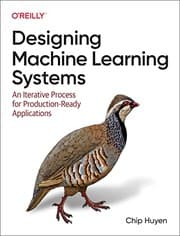
Designing Machine Learning Systems
Chip Huyen
By the end of Designing Machine Learning Systems, “it worked on my machine” stops being an acceptable failure mode.
Design for feedback loops, not one-time training runs.
It forces an end-to-end view: data issues, training choices, deployment constraints, and operational feedback loops. That lens fits MLOps by turning vague best practices into concrete production tradeoffs you can reason about and ship.
Machine Learning Engineering
Andriy Burkov
Machine Learning Engineering turns the lifecycle into a system you can manage, not a collection of disconnected steps.
Treat ML like an engineering discipline with a lifecycle.
Burkov targets ML engineering workflows and operational practices, emphasizing how teams build, iterate, and keep systems healthy. For an MLOps role, it helps you speak the language of lifecycle decisions and reliability constraints from day one.
Reliable Machine Learning
Cathy Chen, Niall Richard Murphy, Kranti Parisa, D. Sculley, Todd Underwood
Reliable Machine Learning makes reliability and observability first-class features of ML, not afterthoughts.
Make model behavior observable with clear signals.
It focuses on operating ML services: measurement, monitoring, and making failures diagnosable. For MLOps engineers, that emphasis changes what you build around the model so production issues become tractable instead of mysterious.
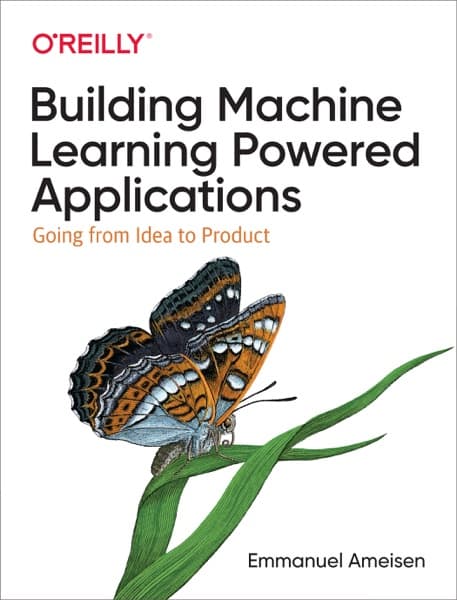
Building Machine Learning Powered Applications
Emmanuel Ameisen
Building Machine Learning Powered Applications reframes MLOps as product iteration: rapid experimentation backed by production constraints.
Close the loop: deploy, measure, retrain with intent.
Ameisen emphasizes shipping ML-powered products and managing the loop between data, model changes, and real-world behavior. That maps directly to MLOps work where deployment discipline and iteration velocity must coexist.
Practical MLOps
Noah Gift, Alfredo Deza
Practical MLOps helps you operationalize ML with automation and repeatability, so training and deployment stop drifting over time.
Automate the pipeline to reduce configuration drift.
It explicitly covers MLOps workflows: how to deploy, automate steps, and manage production concerns. For MLOps engineers, it supports the practical “what do we build next” mindset that production systems demand.
Introducing MLOps
Mark Treveil, Nicolas Omont, Clément Stenac, Kenji Lefevre, Du Phan, Joachim Zentici, Adrien Lavoillotte, Makoto Miyazaki, Lynn Heidmann
Introducing MLOps gives you a shared map of roles, lifecycle stages, and tooling so teams stop talking past each other.
MLOps is lifecycle management, not a single tool.
It’s an approachable overview of the MLOps landscape with a lifecycle-oriented framing of what gets managed where. That helps MLOps engineers quickly align with stakeholders and identify where process and tooling should plug in.
Treat ML like an engineering discipline with a lifecycle.
Machine Learning Design Patterns
Valliappa Lakshmanan, Sara Robinson, Michael Munn
Machine Learning Design Patterns replaces improvisation with proven patterns for building robust, maintainable production ML.
Use design patterns to standardize production ML decisions.
It focuses on implementation patterns that support reliability and maintainability, which directly affects the operational behavior of ML systems. For MLOps engineers, it gives concrete building blocks for reducing production surprises.
Fundamentals of Data Engineering
Joe Reis, Matt Housley
Fundamentals of Data Engineering sharpens your MLOps instincts at the source: pipelines and data reliability drive downstream model health.
Data reliability is a prerequisite for reliable ML.
MLOps depends on trustworthy data flows, and this book strengthens the infrastructure foundation behind training and monitoring. It matters because many production ML failures are data and pipeline failures wearing a model’s clothes.
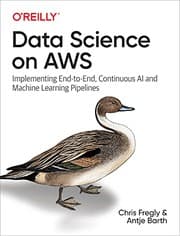
Data Science on AWS
Chris Fregly, Antje Barth
Data Science on AWS reframes ML operations through cloud-native architecture decisions, from training to deployment and monitoring.
Choose architecture that matches deployment and operational needs.
It offers a production-oriented AWS view that connects infrastructure choices to ML deployment realities. For MLOps engineers working on AWS environments, it grounds operational decision-making in concrete platform capabilities.
Can we tailor this list for you?
Type your question in the bar below and the AI will tailor a fresh set of picks just for you.