Best Framework-Driven Product Management Books
Ten framework-heavy product-management books: opportunity-solution trees, shaping versus estimates, system-dynamics leverage points, OKR design. For PMs who want models they can carry into Monday's planning meeting.
Sprint
Jake Knapp, John Zeratsky, Braden Kowitz
The five-day design-sprint process that Google Ventures used to test ideas before building them, now adopted by thousands of teams.
The way to make better decisions is to make them with data you didn't have yesterday.
Knapp invented the design sprint at Google to compress months of decisions into a single week. The book is the operating manual: Monday for the problem, Friday for the user test, with structured exercises that produce alignment without endless meetings. Worth reading even if you never run a sprint, the underlying ideas about decision-making and prototyping land in any planning context.
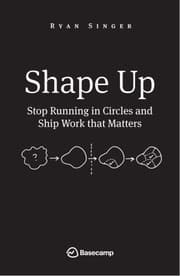
Shape Up
Ryan Singer
Basecamp's alternative to sprints, six-week appetites, shaped pitches, and the betting table that decides what gets built.
Estimates are guesses. Appetites are decisions.
Singer ran product at Basecamp for two decades and codified the operating system that lets them ship without sprints, story points, or backlogs. Shape Up isn't right for every company, but the underlying ideas, fixed time, variable scope; shaping before betting; circuit-breakers instead of carryover, are the most original take on product process published in the last decade. Free online; worth the price either way.
The Lean Product Playbook
Dan Olsen
The most actionable book on finding product-market fit, six steps, with worksheets, that walk you from problem to MVP.
Most products fail because the team built the wrong thing well, not because they built the right thing badly.
A pure framework: the Product-Market Fit Pyramid broken into six sequenced layers with a template for each. Olsen hands you a repeatable procedure for defining a product, which is exactly what a methods-first reader wants on the shelf.
Continuous Discovery Habits
Teresa Torres
A weekly cadence for customer discovery that PMs can actually keep up, opportunity-solution trees, assumption tests, and the discipline of small steady habits.
Continuous discovery is a habit, not a project, a small interview every week beats a big study every quarter.
This is the framework book for discovery: the opportunity-solution tree, the weekly interview cadence, and structured assumption tests. Torres gives you a named, drawable process rather than a philosophy, which is precisely what a methods-first reader is after.
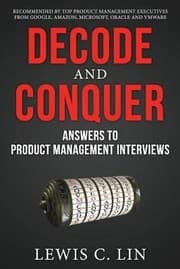
Decode and Conquer
Lewis Lin
The most thorough PM interview prep book, frameworks for every kind of question, with worked answers from real interviews at FAANG.
An interview answer is a structured story. Without structure, you sound smart but unhirable.
Lin runs Impact Interview, the prep service most aspiring PMs end up paying for; this is the book version. CIRCLES for product design, AARM for metrics, the BLUF framing for case interviews, frameworks that hold up under pressure and don't sound rehearsed. Pair it with Cracking the PM Interview for full coverage of the loop.
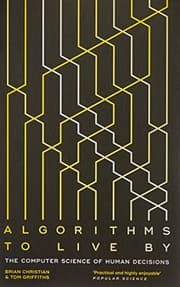
Algorithms to Live By
Brian Christian, Tom Griffiths
A computer scientist and a journalist take computer-science algorithms, sorting, scheduling, caching, exploration vs. exploitation, and apply them to everyday decisions.
The 37% rule: spend the first 37% of your search looking, and commit to the best option you've seen after that.
Christian and Griffiths turn the kind of thinking PMs do at work into the same kind of thinking they should be doing about meetings, inboxes, and life choices. The chapter on explore/exploit is genuinely useful in product prioritization (and in deciding whether to try a new restaurant). One of the most quietly enjoyable books on this list, and the rare one that gets more interesting on a reread.
Estimates are guesses. Appetites are decisions.
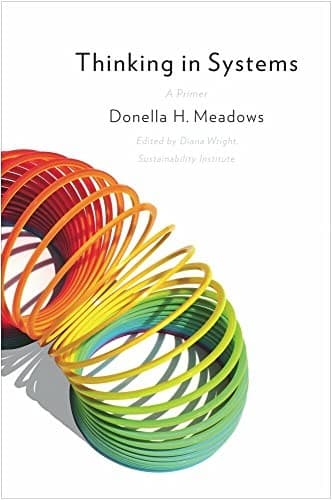
Thinking in systems
Donella H. Meadows, Diana Wright
A primer on how systems behave, written by one of the founders of system dynamics, feedback loops, stocks and flows, leverage points where small changes shift everything.
The least obvious leverage point in a system is usually the most powerful.
Meadows worked on Limits to Growth and spent her life teaching people to see systems the way engineers see circuits. This posthumous book is the gentlest, most quotable entry point. The list of twelve leverage points alone, places where a small intervention changes a system's behavior, is worth carrying mentally into any product strategy meeting. Slim, deep, and the kind of book senior PMs cite years after reading.
Good Strategy, Bad Strategy
Richard P. Rumelt
A UCLA strategy professor on what real strategy looks like, diagnosis, guiding policy, coherent action, and why most documents called "strategy" are wish lists.
A strategy that doesn't name the obstacle isn't a strategy. It's a wish.
Rumelt is sharp, mean about fluff, and the book is the closest thing to a strategy boot camp in print. The chapter on the kernel of good strategy is the cleanest definition you'll find, and his takedowns of bad strategy (fluff, failure to face the challenge, mistaking goals for strategy) make any subsequent strategy doc you read measurably more annoying. Worth that price.
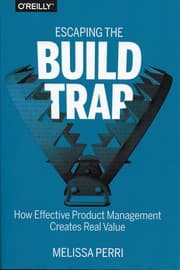
Escaping the Build Trap
Melissa Perri
Why most product teams ship a lot and learn nothing, and how to climb back out toward outcomes that actually matter.
Shipping is not progress. Output is not outcome. The build trap is mistaking the first for the second.
Perri turns stop shipping for its own sake into a concrete operating model: the product-strategy framework, the product kata, and the org structures that actually produce outcomes. It is the systems-level framework for why teams drift and how to reset them.
Can we tailor this list for you?
Type your question in the bar below and the AI will tailor a fresh set of picks just for you.