Best Books on Debate
Debate books that train real argument instincts: from Jay Heinrichs on persuasion to Douglas Walton on informal logic. The shared thread is practical fallacy detection and tighter reasoning under pressure.
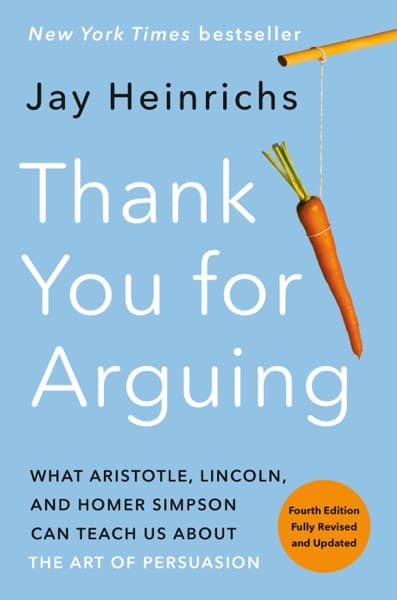
Thank You for Arguing
Jay Heinrichs
After Heinrichs, you stop arguing with opinions and start arguing with moves: you anticipate objections, disarm bad-faith tactics, and control the frame.
Steelman before you attack; charity reduces needless rebuttal.
This book teaches persuasion as a set of usable rhetorical decisions, not a theory you admire from a distance. That matters for debate because winning often comes from spotting the other person’s strategy and choosing the next best move.
The Art of Always Being Right
Arthur Schopenhauer, A. C. Grayling
Schopenhauer turns “winning” into a catalog of maneuvers so you can recognize them in others and refuse to be baited by them.
A dishonest opponent relies on tone, not reasons.
Rather than only teaching logic, it exposes the rhetorical tricks people use to dodge standards of proof. In debate, that helps you keep the discussion anchored to reasons instead of getting dragged into pure cleverness.
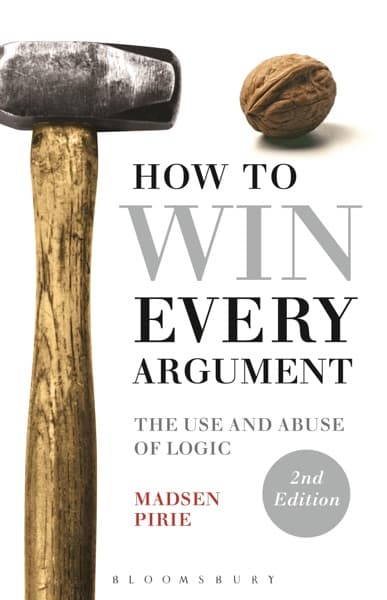
How to Win Every Argument
Madsen Pirie
Pirie replaces performance bravado with disciplined reasoning: once you learn common argument tactics, your confidence comes from method, not volume.
Test arguments by relevance, not persuasion.
This guide sharpens your ability to see how arguments are structured and where they tend to slip. For debate, that means fewer rhetorical detours and more precise responses to what was actually claimed.
A rulebook for arguments
Anthony Weston
Weston gives you a compact way to check arguments for clarity and evidence so your rebuttals target the actual weak point.
State a claim, then ask what justifies it.
It’s built for the moment you draft or evaluate: identify claims, demand support, and respond to objections cleanly. That directly supports debate prep because your best lines come from diagnosing the argument, not just reacting to it.
Argumentation and Debate
Austin J. Freeley, David L. Steinberg
This text makes debate feel procedural: once you know the standard expectations, your cases and rebuttals stop sounding improvisational.
Rebut the reasoning, not just the conclusion.
It focuses on how debate arguments are constructed and evaluated in recognized formats. That matters because debate performance often turns on meeting the rules of what counts as a relevant, answerable argument.
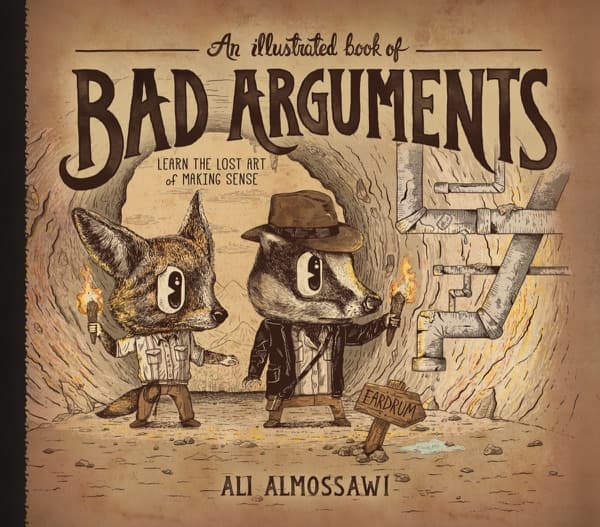
An Illustrated Book of Bad Arguments
Ali Almossawi, Alejandro Giraldo
After seeing the fallacies as cartoons and patterns, you start catching argument poison fast, even when it’s delivered confidently.
Every fallacy has a recognizable “pattern of blame.”
The visual format lowers the barrier to learning the most common reasoning errors that derail debates. If you want immediate improvement in what you notice and call out, this makes the warning signs memorable.
A dishonest opponent relies on tone, not reasons.
The Uses of Argument
Stephen E. Toulmin
Toulmin gives you a sharper debate vocabulary: you stop treating arguments as “true or false” and start mapping claims to warrants.
Warrant connects claim to grounds.
Its framework turns rebuttals into targeted questions about support, backing, and the link between evidence and claim. That is especially valuable in debate because many conflicts are really disputes about the warrant.
Informal Logic
Douglas Walton
Walton turns fallacies from vague accusations into analyzable argument patterns you can contest precisely.
Look for argumentation schemes and critical questions.
Informal logic is about real-world argument, including how disputes proceed when people use loaded language or partial support. For debate, that means better analysis of why a counterargument fails or succeeds beyond surface cleverness.
Can we tailor this list for you?
Type your question in the bar below and the AI will tailor a fresh set of picks just for you.