Best Books on Game Theory
Game theory is the math of strategic decisions, and these five books make it usable. Schelling's The Strategy of Conflict and Dixit and Nalebuff's Thinking Strategically turn equilibrium logic into moves you can make under uncertainty.

Thinking Strategically
Avinash K. Dixit, Barry J. Nalebuff
By the end, every dispute feels like a coordination problem or a bargaining game you can reason about, not a vague conflict.
Master backward induction with incentives and commitment levers
It teaches game theory as a set of reusable decision lenses, using business, politics, and everyday moves to show how to model incentives and commitments. That matters for game theory because it trains you to translate real situations into strategic questions instead of getting stuck in formalism.

The strategy of conflict
Thomas C. Schelling
You learn why bargaining is often about credibility and leverage, not about numbers on a table.
Make threats credible through commitment constraints
Schelling reframes strategy around coercion, deterrence, and commitment, explaining how side payments and threats work when rationality is shared but distrust is real. This fits game theory because it expands your perspective from equilibria to the human mechanisms that make equilibria possible.
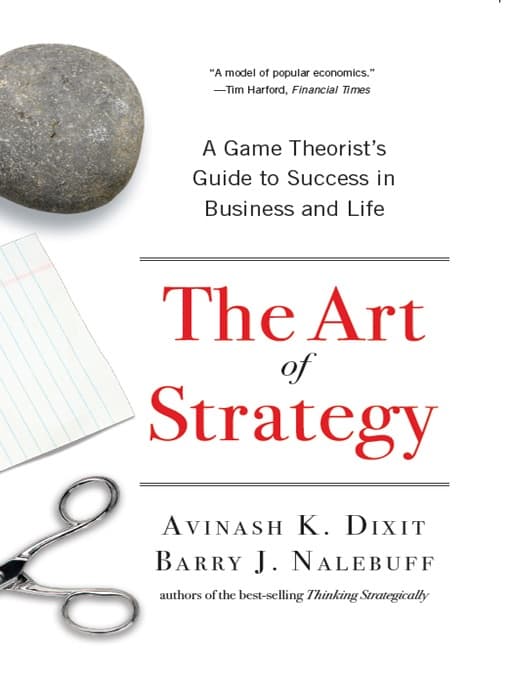
The Art of Strategy
Avinash K. Dixit, Barry J. Nalebuff
It teaches you to treat decisions like chess openings: analyze incentives early, then exploit asymmetries as the game evolves.
Create advantage: move first, commit, or signal
Compared with a purely academic entry, this one broadens strategic thinking into practical reasoning tools tied to many classic game theory ideas. For your query, it helps you move from “I know the concept” to “I can apply it,” especially when stakes are real and not purely theoretical.
The Joy of Game Theory
Presh Talwalkar
By treating games like brain teasers, it makes equilibrium feel like a pattern you can spot, not a theorem you memorize.
Look for dominance and equilibrium in simple games
Talwalkar’s puzzle-driven approach lowers the intimidation barrier and builds intuitive mastery before you need heavy math. That matters if you want game theory that sticks: you learn by repeated small shocks of “oh, that’s what’s going on.”
Prisoner's dilemma
William Poundstone
You watch game theory develop through personalities and experiments, and the history makes the core logic feel inevitable.
Repeated games reward reciprocity with memory
Poundstone combines narrative and experimental accounts to explain why the prisoner’s dilemma became a cultural and scientific centerpiece. For your goal, it gives you durable intuition by showing how researchers tested ideas, not just how they stated them.
Can we tailor this list for you?
Type your question in the bar below and the AI will tailor a fresh set of picks just for you.