Best Books on AI Agents
An agent is the oldest idea in artificial intelligence, and suddenly its newest product. These books trace the thread from the textbook definition of a rational agent, through reinforcement learning and multi-agent systems, to the language-model agents now writing code and completing tasks on their own.
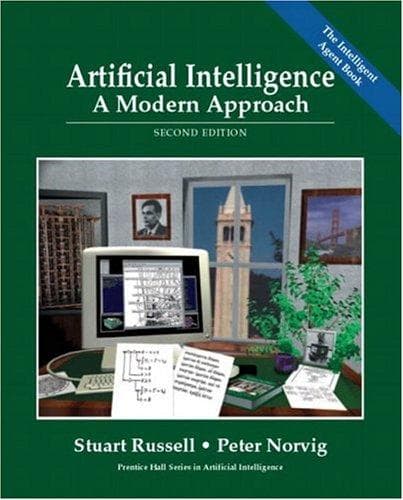
Artificial Intelligence
Stuart J. Russell, Peter Norvig
The textbook that made 'agent' the organizing idea of all AI.
Every agent reduces to four things: sensors, actuators, a performance measure, and an environment. Specify those four and you have specified the problem.
Russell and Norvig build the entire field around one abstraction, an agent that perceives its environment and acts to maximize a performance measure, still the cleanest definition you will find of what an agent actually is.
Reinforcement Learning, second edition
Richard S. Sutton, Andrew G. Barto
How an agent learns to act when nobody labels the right answer.
Reward is not the goal you care about, it is the only signal the agent ever sees. Specify it carelessly and the agent optimizes exactly what you wrote, not what you meant.
Sutton and Barto formalize the agent that learns purely from reward, and their framework of states, actions, value, and policy is the direct ancestor of the training loops behind AlphaGo and today's tool-using agents.
An Introduction to MultiAgent Systems
Michael Wooldridge
What changes the moment agents must reason about other agents.
A single agent optimizes; a group of agents bargains. Once there are two of them, coordination, not raw intelligence, becomes the hard part.
Wooldridge is the standard text on systems of many agents, covering how autonomous agents negotiate, cooperate, and compete, exactly the questions that resurface the instant you let more than one LLM agent share a task.
AI Engineering
Chip Huyen
Turning a foundation model into an agent that survives production.
An agent's reliability is its per-step success rate raised to the number of steps. Ninety-five percent per step is barely a coin flip after fourteen actions.
Huyen treats agents as an engineering discipline, covering tool use, planning, evaluation, and failure modes, so you understand why a demo agent dazzles and a deployed one quietly breaks on the tenth step of a real task.
Hands-On Large Language Models
Jay Alammar, Maarten Grootendorst
The visual, build-it path into how an LLM agent actually runs.
An LLM agent is a loop: the model proposes an action, your code runs it, and the result goes back into the prompt. The 'agent' is mostly that loop around a text predictor.
Alammar and Grootendorst expose the machinery under an agent, embeddings, tokens, prompting, and tool calling, with the clear diagrams Alammar is known for, making it the best on-ramp before you wire up any agent framework.
AI Agents in Action
Micheal Lanham
A hands-on build of agents that plan, remember, and use tools.
Give an agent memory and tools before you give it autonomy. An agent that cannot recall its last step has no business choosing the next one.
Lanham assembles working agents from the parts that actually matter, memory, planning, tool use, and multi-agent collaboration, so the abstract control loop turns into code you can run, break, and fix yourself.
Reward is not the goal you care about, it is the only signal the agent ever sees. Specify it carelessly and the agent optimizes exactly what you wrote, not what you meant.
The society of mind
Marvin Minsky
A whole mind built from thousands of agents too dumb to think.
You do not need a smart part to build a smart whole. Intelligence can be an emergent property of many agents that individually comprehend nothing.
Minsky argues intelligence has no center and emerges from countless simple processes he calls agents, each understanding nothing alone, a startlingly modern lens on what swarms of narrow AI components are doing right now.
Vehicles
Valentino Braitenberg
Two wires and a sensor, and behavior that looks like fear and love.
Complex behavior is a poor guide to complex internals. An observer always overestimates the mind behind a simple agent moving through a rich world.
Braitenberg builds imaginary agents from almost nothing, a sensor wired straight to a motor, then shows how quickly purposeful-looking behavior emerges, a humbling lesson in how little machinery agency actually requires.
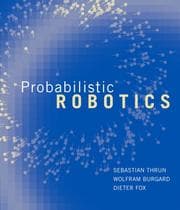
Probabilistic robotics
Sebastian Thrun, Dieter Fox, Wolfram Burgard
The agent that has to act while genuinely unsure where it is.
A capable agent does not track the world, it tracks a probability distribution over possible worlds, and acts well precisely because it knows what it does not know.
Thrun, Burgard, and Fox tackle the embodied agent that must decide under uncertainty, building the probabilistic methods that let a robot localize, map, and act when every sensor reading is noisy and incomplete.
Can we tailor this list for you?
Type your question in the bar below and the AI will tailor a fresh set of picks just for you.