Best Books on Epidemiology
Epidemiology shines when methods become a way of thinking: Leon Gordis’s Epidemiology for foundations, Rothman, Greenland & Lash’s Modern Epidemiology for causal inference, and Field Epidemiology by Michael B. Gregg for real outbreak reasoning.
Epidemiology
Leon Gordis
After Gordis’s Epidemiology, epidemiology stops feeling like statistics and starts feeling like a disciplined way to translate evidence into decisions.
Risk difference beats odds ratio for public meaning
It builds the core measures, study designs, and reasoning steps in a single through-line, so you can recognize what a claim is really using. That matters because epidemiology is less about formulas and more about matching a question to the right design and bias checks.
Modern Epidemiology
Kenneth J. Rothman, Sander Greenland, Timothy L. Lash
Modern Epidemiology changes your default: you begin to see bias, confounding, and causality as the actual problem, not an afterthought.
Counterfactuals define causal estimands
Rothman, Greenland, and Lash put causal inference at the center, with clear mechanisms for confounding and bias that sharpen interpretation of results. If your goal is to reason from data to causes, this is where the lens becomes rigorous.
An Introduction to Epidemiology
Thomas C. Timmreck
Timmreck’s An Introduction to Epidemiology turns vague “population thinking” into concrete measures you can explain without hand-waving.
Incidence and prevalence tell different stories
It’s a straightforward survey of epidemiologic concepts, so you can build vocabulary and basic intuition before tackling analytic depth. Use it when you need an approachable on-ramp to epidemiologic measures and applications.
Epidemiology for Public Health Practice
Robert H. Friis, Thomas Sellers
Friis and Sellers connect epidemiology to the choices public health teams actually make: what to measure, what to prioritize, and how to justify action.
Translate evidence into actionable surveillance decisions
The book bridges methods to practice, so the “why this design” logic stays tied to real-world constraints and decisions. That makes it especially helpful when you want epidemiology to guide interventions, not just describe disease.
A Dictionary of Epidemiology
Professor of Preventive Medicine and Public Health Miquel Porta
After A Dictionary of Epidemiology, key terms stop colliding in your head and start carrying precise meaning again.
Confounding has a defined causal role, not vibes
Porta clarifies canonical definitions across study designs, measures, and causal language, reducing confusion that often comes from inconsistent usage. If you are learning epidemiology, this reference keeps your interpretation aligned with standard definitions.
Field Epidemiology
Michael B. Gregg
Field Epidemiology makes outbreak work feel navigable: you learn how evidence gets built under pressure and uncertainty.
Generate hypotheses early, test fast, iterate
Gregg emphasizes applied outbreak investigation and practical epidemiologic work, so you focus on what to do with cases, exposures, and hypotheses in real settings. It fits anyone who wants epidemiology as field-ready reasoning rather than purely academic analysis.
Counterfactuals define causal estimands
Epidemiology in medicine
Charles H. Hennekens
Epidemiology in medicine trains you to question clinical conclusions using epidemiologic reasoning you can actually use at the bedside.
Relative measures mislead without baseline risk context
Hennekens translates core epidemiologic logic into medical decision-making, so study results become interpretable inputs rather than labels. This matters when you want to connect epidemiologic thinking to how clinicians read evidence.
Epidemiology
Moyses Szklo, F. Javier Nieto
Szklo and Nieto’s Epidemiology makes analytic epidemiology feel systematic: you learn to see what threatens validity before chasing results.
Confounding control starts with design
It bridges from concepts into the applied analytic toolkit while keeping an emphasis on study design and correct interpretation. That helps when you want more than definitions: you want a map from question to analysis to valid inference.
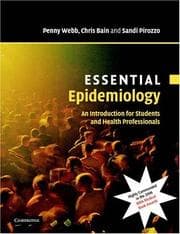
Essential Epidemiology
Penny Webb, Chris Bain
Essential Epidemiology gives you a clean, usable mental model so epidemiologic claims become easy to interpret and challenge.
Odds ratio approximates risk ratio only under rare outcomes
It’s concise and approachable, focusing on the core ideas and how they show up in practice. Use it when you need clarity fast without losing the logic behind measures and study types.
Can we tailor this list for you?
Type your question in the bar below and the AI will tailor a fresh set of picks just for you.