Best Books on Brand Strategy
Brand strategy sharpens when you stop treating branding as visuals: The 22 immutable laws of branding and Aaker’s Building Strong Brands give a rules-and-equity lens for building durable differentiation.
The 22 immutable laws of branding
Al Ries
After this book, “branding” feels like decisions with consequences: you learn how consistency and differentiation compound, and how shortcuts cost you shelf space forever.
Brand is the sum of perceptions, not promises.
Ries turns brand-building into a small set of enforceable laws with clear cause-and-effect. That helps when brand strategy needs a defensible, repeatable logic for what to protect and what to change.
Building Strong Brands
David A. Aaker
You’ll come away thinking in brand assets: equity, associations, and loyalty trade-offs replace vague “good branding” opinions.
Measure brand strength through brand equity components.
Aaker maps brand equity into practical components and shows how strategy choices create or erode value. That matters for brand strategy because it gives you a way to reason about long-term strength, not just campaigns.
Purple Cow
Seth Godin
Brand strategy becomes a system you can explain: customer mindsets, brand meaning, and equity mechanics connect to every decision you make.
Customer-based brand equity drives strategy choices.
Keller synthesizes how brand knowledge forms and how to design and manage brand architecture. For brand strategy work, it sharpens your ability to evaluate what your brand currently stands for and how to build it.
How Brands Grow
Jenni Romaniuk, Byron Sharp, Professor of Marketing Science and Director of the Ehrenberg-Bass Institute Byron Sharp
This book reframes growth around physical availability and memory links, not heroic creativity alone.
Increase distinctive mental links, not just persuasion.
Romaniuk and Sharp use evidence to challenge conventional assumptions about persuasion-heavy branding. If your strategy depends on “changing minds,” this gives a counterweight: build distinctive brands that stay salient and reachable.
Designing brand identity
Alina Wheeler
Brand identity stops being a logo exercise: you learn how strategy choices become identity systems that actually hold up in the real world.
Identity is strategy expressed consistently.
Wheeler connects positioning and brand strategy to tangible identity elements and implementation. That helps when brand strategy must translate cleanly into what people see, feel, and experience.
Zag
Marty Neumeier
After Zag, differentiation sounds like a decision rule: you define what you will do and what you will refuse to be.
Make a choice: zag, or be forgotten.
Neumeier distills positioning into sharper trade-offs, pushing you toward brands that stand for something distinct. For brand strategy, it’s useful when you need a clearer answer than “be better” in crowded categories.
Measure brand strength through brand equity components.
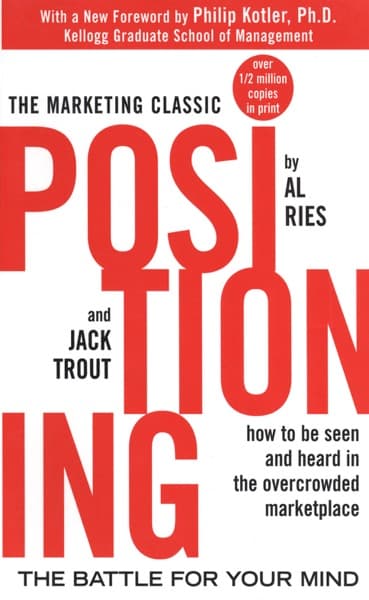
Positioning
Al Ries, Jack Trout
You start seeing the market as a mental map, and brand strategy as the work of taking or defending a position in it.
Win a position in the prospect’s mind.
Ries and Trout lay out category positioning and competitive perception in a way that’s easy to apply to real brand problems. It matters for brand strategy because it forces clarity about where you sit versus where rivals sit.
Kellogg on Marketing
Alice M. Tybout, Bobby J. Calder
Marketing turns from opinion to tested principles: you’ll learn how to justify brand strategy with research-backed thinking.
Use evidence to choose strategy, not vibes.
This expert-edited primer translates core strategy concepts into practical guidance you can use in decision-making. For brand strategy, it complements frameworks by grounding choices in how customers and markets actually respond.
Can we tailor this list for you?
Type your question in the bar below and the AI will tailor a fresh set of picks just for you.