In 2003, a Tennessee accountant named Chris Moneymaker turned an $84 online satellite entry into a $2.5 million World Series of Poker victory. That single event ignited a global boom, but it also triggered a more subtle shift: it transformed poker into a data science. Before the "Moneymaker Effect," poker was largely a game of "feel" and smoky backrooms. Today, the game is a battle of mathematical equilibrium. Players now use solvers to calculate the precise frequency of a bluff with clinical accuracy.
The physical bookshelf remains the essential repository for this evolving strategic landscape. While information is the currency of the table, the medium has changed. We have moved from the "outlaw" era of intuition to a "quant" era of logic. To win in today's games, you cannot rely on "reading souls" alone; you need a structured library.
The Great Divide: Traditional Intuition vs. Modern Solver Theory
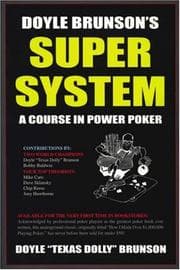
The history of poker literature is a tale of two philosophies. On one side are "Old School" legends like Doyle Brunson. His 1978 masterpiece, Super/System, essentially taught a generation how to play "Power Poker." Brunson's logic was revolutionary: aggression is a weapon. He argued that it is better to be the one putting an opponent to a decision for their entire stack than to be the one making the call.
However, the game evolved. In the early 2010s, the introduction of "solvers" (AI programs like PioSOLVER) changed the fundamental objective. The focus shifted away from "exploitative play" (guessing what the opponent holds) and toward "Game Theory Optimal" (GTO) play. GTO is a strategy that, if executed perfectly, cannot be beaten even if your opponent knows your exact strategy. It is the mathematical edge of the modern professional.
But there is a catch: humans are not computers. We cannot memorize a billion different hand-tree combinations. The best modern books focus on the "translation layer." They teach you how to take a computer's cold output and turn it into a winning human decision.
The Foundations: Why Theory Trumps Luck
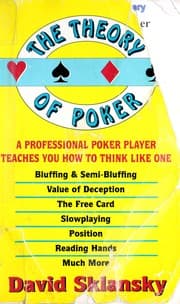
Every winning session is built on the concept of Expected Value (EV). In simple terms, you are not trying to win every hand; you are trying to make decisions that, if repeated a thousand times, result in a net profit. David Sklansky's The Theory of Poker (1987) remains the foundational text of this concept.
Sklansky introduced the Fundamental Theorem of Poker: Every time you play a hand differently from the way you would have played it if you could see all your opponents' cards, they gain; and every time you play your hand the same way you would have played it if you could see all their cards, they lose. This principle is the cornerstone of every strategy developed since. Whether you are playing a $1/$2 cash game in a local casino or a $100,000 High Roller, this logic holds.
The Essential Poker Reading List
Core Curriculum for Beginners
- The Theory of Poker by David Sklansky
- The Context: The book that moved poker out of the saloons and into the halls of logic.
- The Utility: This is the definitive foundational work. It ignores specific game variants like Texas Hold'em to focus on the underlying laws of probability that govern all gambling.
- The Key Concept: The "Fundamental Theorem of Poker," which defines the relationship between information and profit.
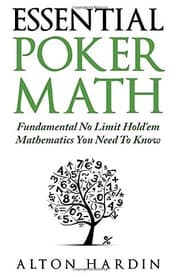
- Essential Poker Math by Alton Hardin
- The Context: A clear, jargon-free guide to the only numbers you actually need to win.
- The Utility: An actionable, modern guide for those who are intimidated by spreadsheets. It covers pot odds, equity, and the "Rule of 2 and 4" in a way that is immediately applicable at the table.
- The Key Concept: Calculating "outs" instantly to determine if a call is mathematically profitable or a long-term disaster.
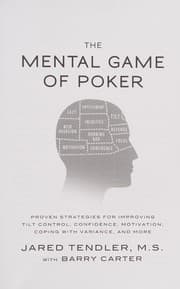
- The Mental Game of Poker by Jared Tendler
- The Context: An exploration of why players lose because of their psychology, not their cards.
- The Utility: You can have the best strategy in the world, but if you "tilt" (lose emotional control) after a bad beat, your strategy is worthless. Tendler treats poker like a professional sport, focusing on performance and emotional endurance.
- The Key Concept: The "Inchworm Effect," which posits that your best play only improves when you focus on fixing the consistent mistakes in your worst play.
Strategic Advanced Theory
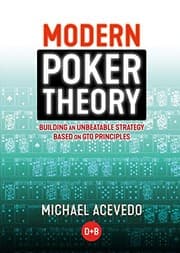
- Modern Poker Theory by Michael Acevedo
- The Context: A comprehensive translation of how AI solvers view the game, made digestible for humans.
- The Utility: If Sklansky is the "Old Testament," Acevedo is the "New Testament." He uses data from thousands of hours of computer simulations to show you how to build a "balanced" range that is impossible to exploit.
- The Key Concept: "Minimum Defense Frequency" (MDF), the formula that tells you exactly how often you must call a bet to prevent your opponent from bluffing profitably with any two cards.
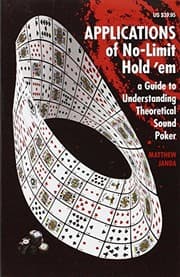
- Applications of No-Limit Hold 'em by Matthew Janda
- The Context: The first book to truly explain why "balancing your range" matters in every single pot.
- The Utility: Janda provides a deep, theoretical look at how to construct a strategy that is unexploitable. This is a vital niche pick that bridges the gap between basic strategy and computer-perfect play.
- The Key Concept: The logic of "bet sizing," explaining why certain board textures require huge over-bets while others require small, probing wagers.
The Strategic Path: A 3-Book Learning Blueprint
If you are serious about moving from a losing player to a winning one, you need a curriculum. Jumping between random videos is a recipe for a drained bankroll. Instead, follow this path:
- Phase One (The Logic): Start with The Theory of Poker by David Sklansky. Understand the primary reasons we bet: for value or as a bluff.
- Phase Two (The Math): Move to Essential Poker Math by Alton Hardin. You must be able to calculate pot odds and equity in your head in seconds.
- Phase Three (The Application): Finish with Modern Poker Theory by Michael Acevedo. This is where you learn to construct "ranges," shifting your focus from "What does he have?" to "What does his entire range of hands want to do here?"
Reading is only half the battle. The other half is the discipline to apply this knowledge against players who have not done the work. The edge in poker is not luck; it is the commitment to study while others are just gambling.
Key Takeaways
- The Fundamental Theorem: Your goal is to make the same decision you would make if you could see the opponent's cards.
- GTO vs. Exploitative: GTO is your defensive baseline; exploitative play is how you maximize profit against weak opponents.
- The Mental Game: Variance is a mathematical certainty. Your job is to manage your reaction to it, not to avoid it.
What is the best poker book for beginners?
The Theory of Poker is the best first book because it teaches the core logic of poker, not just one game variant. Once that clicks, Essential Poker Math makes the numbers usable at the table.
Should I read GTO poker books before learning poker math?
No. Essential Poker Math should come first if you need help with pot odds, equity, and outs. Modern Poker Theory makes more sense after you can already do the basic math quickly.
What poker book helps with tilt and mental game issues?
The Mental Game of Poker is the one to read if variance wrecks your decision-making. It treats tilt like a performance problem, which is exactly how serious players should handle it.
Books mentioned in this article
Want more books like these?
Tell us what you're in the mood for and get 3 perfect picks.
Discover your next read→