
There is a specific, almost painful itch that starts at the base of your skull when you've spent too many hours staring at a backlit screen. It's the realization that your entire life has been captured by a series of invisible, humming grids. Maybe that's why we are currently obsessed with stories about people who simply walked away. Not the "prepper" types who build bunkers and wait for a nuclear winter, but the ones who looked at the modern world and said, "No, thank you," before vanishing into the tree line.
Isolation fiction isn't about adventure anymore. It's a collective hallucination of freedom. When we read about someone living off the grid, we aren't looking for a manual on how to skin a rabbit. We are looking for a way to reclaim our own attention. We want to know if a human being can still exist if no one is "liking" their existence.
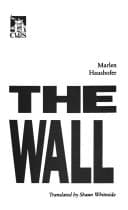
The Brutal Silence of Marlen Haushofer's The Wall
If you want a cozy story about a cabin in the woods, stay away from The Wall. This book is a psychological meat grinder. Written by Marlen Haushofer in the early sixties, it starts with a premise that sounds like a B-movie: a woman is at a hunting lodge when an invisible wall suddenly drops, cutting her off from the world. Everyone else is dead, or frozen, or gone.
But Haushofer doesn't care about the wall. She cares about the cat, the cow, and the protagonist's slow descent into a biological reality. The prose is so lean it's practically skeletal. There are no long, flowery descriptions of nature. Instead, you get the cold, hard facts of survival: the frost that kills the potatoes, the weight of a dead deer, the terrifying responsibility of keeping a cow alive when you are the only person left on earth.
What makes this feel so "human" and so uncomfortable is how the main character loses her social identity. She stops thinking of herself as a woman, or a citizen, or even a person with a name. She becomes a part of the forest's timeline. It's a book that forces you to ask: if you were the last conscious entity in your world, what parts of your "personality" would you bother to keep? Most of what we call a "personality" is just a performance for other people. Without an audience, the performance stops.
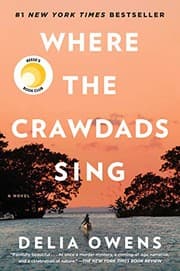
Kya Clark and the Logic of the Mud
Then you have Where the Crawdads Sing. People love to talk about the murder mystery, but let's be honest: the mystery is the least interesting thing about Delia Owens' book. The real heart of the story is the marsh. Kya Clark isn't just a girl who lives in a swamp; she is a biological byproduct of that swamp.
Owens is a scientist, and it shows. She writes about the North Carolina coast with a clinical, almost obsessive detail. Kya's isolation isn't a choice, it's a sentence, but she turns it into an education. She learns about life from the gulls and the tides. She observes the mating habits of insects to understand why her mother left.
It's a story about the "Outsider" in the most literal sense. We live in a world that is obsessed with categorization, and Kya Clark is uncategorizable. She is a glitch in the social system of the nearby town. The power of this book lies in how it validates the hermit. It suggests that there is a deep, sophisticated intelligence in the mud and the water that the "civilized" world has completely forgotten.
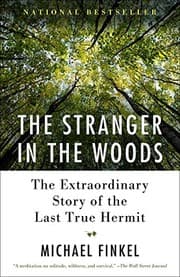
The Man Who Forgot How to Speak: The Stranger in the Woods
There is a true story that reads more like a myth: Christopher Knight. In 1986, he drove his car to the edge of the woods in Maine, left the keys on the dashboard, and walked away. He didn't speak to another human soul for twenty-seven years. Michael Finkel's book, The Stranger in the Woods, tries to figure out why.
Knight wasn't a hero. He was a thief. He survived by breaking into summer cabins and stealing exactly what he needed to survive: food, propane, books. He never lit a fire, even when the temperature dropped to forty below, because he was afraid the smoke would give him away.
When he was caught, the world wanted a guru. They wanted him to tell them the meaning of life. But Knight's answer was much more disturbing: he said that in the silence, his "self" simply dissolved. He wasn't Christopher Knight anymore. He was just a thing that existed in the woods.
This is the ultimate fear and the ultimate fantasy of the modern age. We are so busy "building a brand" and "crafting a narrative" that the idea of simply dissolving into the background is both terrifying and deeply seductive. Knight's story is a reminder that the grid isn't just something we use: it's something that defines us. Without it, we might not even exist.
The Debt We Owe to Thoreau
You can't write about this without mentioning the original "off-grid" influencer: Henry David Thoreau. Walden is a book that everyone pretends to have read but very few actually enjoy. Thoreau was, by all accounts, a bit of a jerk. He was arrogant and he lived close enough to town that his mom could still do his laundry.
But his central premise remains the bedrock of everything we're talking about: "I went to the woods because I wished to live deliberately."
To "live deliberately" in 2026 is a revolutionary act. It means looking at your phone and realizing that your attention is being harvested like a crop. Thoreau's experiment was an audit of the soul. He wanted to see how little he could live on, and in doing so, he realized how much "extra" we carry that actually weighs us down. Every novel about a cabin, every story about a hermit, is just a footnote to Thoreau's realization that the things we own eventually own us.
The Synthesis: Why We Keep Turning the Page
We read these books because they are a safety valve. They allow us to imagine a life where the hum of the refrigerator is replaced by the hum of insects. It's a form of mental "micro-dosing" of solitude.
The characters in these stories have reclaimed their Cognitive Sovereignty. Their lives are hard, and they are often hungry, but their minds belong to them. In a world that wants to sell every second of your attention to the highest bidder, that is the ultimate luxury. We don't read isolation fiction to escape the world; we read it to find the parts of ourselves that the world hasn't managed to monetize yet.
What is the best book about living alone in the woods?
The Wall is the strongest pick if you want solitude without the fantasy gloss. It is brutal, spare, and more interested in what isolation does to the mind than in wilderness survival.
Is Where the Crawdads Sing really about isolation?
Yes, but the marsh matters more than the mystery in Where the Crawdads Sing. Kya’s isolation becomes a way of thinking, not just a plot setup.
What is the true story behind The Stranger in the Woods?
The Stranger in the Woods follows Christopher Knight, who lived alone in the Maine woods for 27 years. It is less a survival tale than a study of what happens when a person disappears from social life.
Books mentioned in this article
Want more books like these?
Tell us what you're in the mood for and get 3 perfect picks.
Discover your next read→