
In 1997, a computer science professor named Sergey Brin co-authored a paper at Stanford titled "The Anatomy of a Large-Scale Hypertextual Web Search Engine." The company built from that paper, Google, went on to mint more than a dozen billionaires and reshape the entire information economy. Entire industries, from journalism to retail, bent themselves around one simple metric: where do you rank on page one?
That era is ending. Not with a bang, but with a text box.
The shift is brutal in its arithmetic. Gartner predicted that by 2026 traditional search engine volume would drop 25%, ceding ground to AI chatbots and virtual agents. ChatGPT alone processes over 3.8 billion visits monthly. When someone asks ChatGPT which accounting software to use, they don't get ten blue links. They get one synthesized answer, citing maybe four or five sources. If your brand isn't in that answer, you're not on page two. You don't exist.
This is where Generative Engine Optimization, or GEO, enters. The term was coined in a landmark 2024 paper by researchers from Princeton University and IIT Delhi, published at the ACM SIGKDD conference. Their finding was counterintuitive: traditional SEO tactics like keyword density had almost no effect on whether AI cited your content. What did work? Adding statistics, including authoritative citations, and writing with genuine fluency. The right combination of these techniques boosted visibility in generative engine responses by up to 40%.
That's a significant number. But GEO is genuinely new, and the books explaining it are only now catching up to the practice. I spent considerable time sorting through what's actually worth reading from what's just repackaged SEO advice wearing a new hat. The list below covers the essential range: the foundational, the immediately actionable, and one that most GEO practitioners haven't even considered yet.
Why GEO Is Not Just "SEO for ChatGPT"
The instinct, for anyone steeped in search marketing, is to treat GEO as a minor adjustment. Change some headers, add some FAQ schema, done. That instinct is wrong, and understanding why requires knowing something about how large language models actually select content.
Traditional search engines crawl, index, and rank pages. The game was about page authority, keyword relevance, and backlink profiles. Generative engines work differently. They retrieve multiple candidate sources, synthesize them using an LLM, and then cite only the two to seven sources they relied on most. The selection criteria are not about domain authority in the classic sense. A 2025 analysis of AI citation behavior found that brand search volume, not backlinks, was the strongest predictor of LLM citations, with a correlation of 0.334. The same research showed that adding statistics to content can increase AI visibility by 22%, while using expert quotations can boost it by 37%.
The competition has shifted from ranking positions to citation slots. And citation slots have a different logic entirely.
There's also the training data problem. LLMs like ChatGPT aren't just pulling from live web results. They carry a vast internal model of the world built from their training corpus. Establishing your brand's presence in that corpus, through Wikipedia pages, mentions in authoritative publications, Reddit threads, and academic papers, is a form of GEO that predates any individual piece of content you publish. Some researchers estimate that around 250 documents mentioning a brand are needed to meaningfully influence how an LLM perceives it. That's a content moat, not a content trick.
The Books That Actually Help
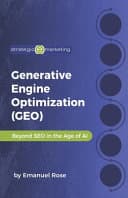
Generative Engine Optimization (GEO): Beyond SEO in the Age of AI — Emanuel Rose (2024)
The Hook: The first standalone book to treat GEO as a discipline in its own right, written by a digital marketing agency founder with 14 years of client-facing experience.
The Why: Rose published this in October 2024, only months after the Princeton paper circulated widely, which gives it a first-mover advantage that's both a strength and a limitation. The book covers the practical shift from keyword-based strategies to content-driven GEO, including how to create content that speaks to both AI models and human readers simultaneously. It works well as a fast orientation for business owners or marketers who need to brief a team without getting deep into the technical weeds.
The Golden Nugget: The most durable insight in Rose's work is that GEO doesn't replace the fundamentals of good content, it amplifies them. Thin content that used to slide by on keyword stuffing now fails twice: once with Google's quality filters and again with AI selection criteria. The bar for content has simply risen, and the old tricks no longer clear it.
Generative Engine Optimization (GEO): The Complete Playbook for Leaders to Win in AI Search — Weiwei Hu (2025)
The Hook: Built for executives, not just marketers, this book introduces a 5-level GEO maturity model that helps organizations assess where they currently stand and what to prioritize next.
The Why: Hu spent over 20 years at the intersection of product strategy, analytics, and AI-led marketing. What separates this book from the crowded field of fast-published GEO titles is the inclusion of detailed case studies from real companies. Patagonia, Glossier, and Slack all appear as examples of how brand visibility in AI-generated answers translates to actual consumer behavior and growth. The statistic she opens with is worth sitting with: 80% of AI-influenced purchases now begin with a single synthesized answer rather than a list of links.
The Golden Nugget: Hu's maturity model reveals an uncomfortable truth that most marketing teams ignore. Most companies are at level one or two, which means they're tracking AI citations reactively, after they've already lost visibility to a competitor. The book's central argument is that GEO is as much an organizational readiness problem as it is a content problem.
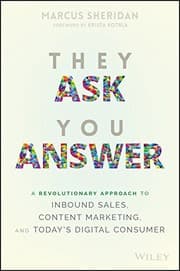
They Ask, You Answer — Marcus Sheridan (2017, revised)
The Hook: Written seven years before GEO was named as a concept, this book accidentally predicted almost everything that makes content perform well with AI systems.
The Why: Here is the unconventional pick. Marcus Sheridan wrote this book after the 2008 financial crisis nearly destroyed his pool installation company, River Pools and Spas. With almost no marketing budget, he started answering customers' real questions on the company's website, directly and without defensiveness, including questions about pricing, problems, and competitor comparisons. River Pools became the most-trafficked pool website in the country. Sheridan traced a single blog post to $3 million in sales.
What Sheridan was describing intuitively is now technically validated by GEO research. The Princeton paper found that content with clear, fluent answers to genuine queries is cited significantly more often by generative engines. Expert quotations, cited sources, and accessible prose all boost visibility. Sheridan's "Big 5" content categories (pricing, problems, comparisons, reviews, and best-in-class lists) map almost perfectly onto what AI engines want to cite, because those are the content types that users most trust. If you want to understand the philosophical spine of GEO without reading a technically dense guide, this is the book.
The Golden Nugget: Sheridan discovered that when prospects read more than 30 pages of a company's content before making contact, the close rate surges to 80%. Compare that to sub-5% when no content is consumed beforehand. AI citation is now doing the same filtering. When ChatGPT cites you as the authoritative answer to a question, you're getting introduced to a buyer who is already convinced you know what you're talking about.
A Practical Guide to Generative Engine Optimization (GEO) — Mahesh Chand (2025)
The Hook: The most framework-dense entry on this list, packed with original tools like the GEO Content Pyramid, the 3-2-1 Rule, and a metric called "Share of Answer" (SoA) that the author argues should replace traditional traffic metrics.
The Why: Chand is the founder of one of the world's largest developer communities, which gives him a perspective grounded in how AI tools are actually used by technical practitioners, not just marketers. The book is organized around industry-specific playbooks: there are dedicated sections for startups, enterprises, healthcare providers, educators, and nonprofits, each with their own GEO constraints and opportunities. This is genuinely useful because GEO optimization is domain-dependent. The Princeton research made exactly this point: citation strategies that work well in legal or financial content differ from those that work in product reviews or historical analysis.
The Golden Nugget: The SoA metric is the book's most original contribution. Share of Answer asks: when a user in your target market queries an AI about your category, what percentage of the answer does your brand or content occupy? It's a more honest measure of AI visibility than simple citation counts, because it accounts for how prominently and how accurately your brand appears in the synthesized response, not just whether you appear at all.
What These Books Can't Tell You (Yet)
GEO is moving fast enough that any book carries an expiration date measured in months rather than years. A few dynamics that none of the current titles fully address:
Only 11% of domains are cited by both ChatGPT and Perplexity, which means visibility on one platform doesn't transfer to another. Brands optimizing for AI search need platform-specific strategies, not a single unified approach. The current books haven't caught up to this fragmentation.
There's also the hallucination problem. AI systems sometimes cite brands with incorrect information or attribute quotes that were never said. Reputation management in the GEO era requires monitoring not just whether you're cited, but what's being said. No current book treats this with the seriousness it deserves.
And then there is the adversarial angle. A 2024 Harvard working paper documented how LLMs can be manipulated to increase product visibility through specific content injection techniques. Whether this is legitimate optimization or manipulation depends heavily on the technique, and the ethics are genuinely unclear. The best GEO practitioners are thinking about these questions now, not after the first major scandal.
Key Takeaways
-
GEO is not a sub-discipline of SEO. It operates on different selection criteria, including statistics, expert citations, fluent writing, and authoritative sourcing, rather than keyword density or backlinks.
-
The Princeton/KDD 2024 paper is still the foundational reference. Any GEO book worth reading should engage seriously with its findings.
-
Emanuel Rose's book is the best fast orientation for practitioners who need to understand the landscape without deep technical context.
-
Weiwei Hu's playbook is built for leadership teams that need organizational frameworks, not just content checklists.
-
Marcus Sheridan's They Ask, You Answer is the sleeper hit of this list. Its content philosophy, written for an entirely different era of search, has become accidentally prescient.
-
Mahesh Chand's practical guide is the most framework-dense and works best for teams that want operational tools, particularly the Share of Answer metric.
-
GEO evolves faster than books. Supplement any of these with ongoing reading from industry practitioners, particularly around platform-specific citation behavior and AI reputation management.
What is the best book on generative engine optimization for beginners?
Generative Engine Optimization (GEO): Beyond SEO in the Age of AI is the best beginner pick. Emanuel Rose gets to the core fast: GEO is about being cited in AI answers, not gaming keywords like old SEO.
Which GEO book is best for executives or leadership teams?
Generative Engine Optimization (GEO): The Complete Playbook for Leaders to Win in AI Search is the one for leadership teams. Weiwei Hu frames GEO as an organizational readiness problem, not just a content task, and her maturity model makes that concrete.
Is They Ask, You Answer still worth reading for AI search optimization?
Yes. They Ask, You Answer is older than GEO as a term, but its advice lines up with what AI systems reward: direct answers, pricing clarity, comparisons, and trust-building content. Read it alongside A Practical Guide to Generative Engine Optimization (GEO) if you want both philosophy and newer operating frameworks.
Books mentioned in this article
Generative Engine Optimization (GEO): The Complete Playbook for Leaders to Win in AI Search
Weiwei Hu
Want more books like these?
Tell us what you're in the mood for and get 3 perfect picks.
Discover your next read→