In 1921, a team of Canadian scientists extracted a crude substance from a dog's pancreas, injected it into a dying 14-year-old boy, and watched his blood sugar drop from near-fatal levels to normal within hours. That substance was insulin. A peptide. The same category of molecule that, a century later, is generating more pharmaceutical revenue than almost anything else on Earth.
Semaglutide, the GLP-1 peptide at the heart of the Ozempic and Wegovy phenomenon, achieved over $12 billion in sales by 2022. Meanwhile, underground peptide communities are self-experimenting with compounds like BPC-157, a 15-amino-acid sequence first isolated from human gastric juice in Croatia in 1992, and TB-500, a synthetic fragment of thymosin beta-4. The science is moving fast, the regulatory picture is murky, and the books that actually explain what's happening, without dumbing it down or dressing it up in wellness-industry hype, are shockingly rare.
This list is built for people who want to understand the biology, not just follow a protocol. Whether you're a clinician, a biohacker with a genuine curiosity for the mechanisms, or someone who's just started hearing the word "peptide" everywhere and wants the real story, these books will do the actual work of educating you.
What Peptides Actually Are (And Why the Distinction Matters)
Most health content treats peptides as a category of supplement. That framing misses something important. Peptides are short chains of amino acids, smaller than full proteins, that act as the body's messaging infrastructure. Hormones, neurotransmitters, immune signals, tissue repair signals: a staggering number of the body's communication systems run on peptides. Insulin is a peptide. So is oxytocin. So is the molecule that tells your stomach you're full.
The reason the therapeutic peptide space is exploding is partly scientific and partly regulatory. Today, close to 100 peptide-based drugs are approved for clinical use globally. What's different now is the frontier: researchers are identifying peptides with increasingly precise and targeted effects, from compounds that selectively promote tendon repair to ones that appear to modulate inflammation in the brain without affecting peripheral tissue. The challenge is that pharmaceutical development timelines are slow, and a robust gray market has emerged around compounds that show promise in animal studies but have not cleared human trials.
This creates a genuine knowledge problem for anyone trying to navigate the space. The books below address different layers of it.
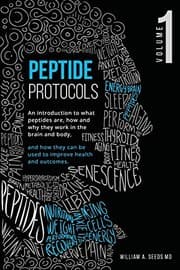
Peptide Protocols, Volume One — William A. Seeds, MD
The first book a physician serious about this field should read.
Dr. Seeds, an orthopedic surgeon who has spent years treating complex patients through a cellular medicine framework, wrote this as a foundational handbook rather than a consumer guide. The focus is on how peptides interact with cellular signaling pathways, how they delay senescence, and why their mechanisms differ so fundamentally from conventional pharmaceuticals. Every protocol is grounded in peer-reviewed literature, which is cited in full throughout.
The book is not light reading. It assumes a baseline of biological literacy and moves quickly through concepts like the nitric oxide system, VEGF-mediated angiogenesis, and inflammatory cytokine cascades. But that density is precisely the point. Most peptide guides flatten the science into a checklist. Seeds refuses to. One Goodreads reviewer with a clinical background noted simply: "Dr. Seeds is the ultimate voice of the peptide movement changing day-to-day medicine."
The takeaway you'll carry: Cellular senescence, the process by which cells stop dividing but refuse to die, may be more therapeutically addressable through targeted peptide signaling than through almost any other intervention currently available.
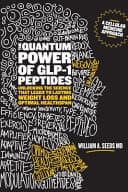
The Quantum Power of GLP-1 Peptides — William A. Seeds, MD
The hype around Ozempic has, paradoxically, obscured what GLP-1 drugs actually do.
Most coverage treats semaglutide as a weight loss drug with a clever mechanism. Seeds argues, with considerable clinical and research support, that this framing undersells the molecule by about an order of magnitude. GLP-1 receptors are expressed not just in the pancreas and gut but in the brain, the heart, the kidneys, and immune tissue. The cardiovascular data alone, showing consistent reductions in major adverse cardiac events across multiple large trials, suggests something more systemic is happening than appetite suppression.
This book is the third in Seeds' series and functions as a corrective to the popular narrative. John Eng's foundational discovery of exendin-4, a GLP-1 analog found in Gila monster venom that was structurally more stable than human GLP-1 (which degrades in under a minute in the bloodstream), is traced here from a laboratory curiosity in the early 1990s to the multi-billion-dollar drug class it eventually became. Eng, incidentally, had to personally patent his discovery and find a partner to develop it, because his hospital showed no institutional interest. That story alone is worth knowing.
The takeaway you'll carry: GLP-1 receptor agonists appear to have neuroprotective properties, with emerging data suggesting potential applications in Alzheimer's and Parkinson's disease that have nothing to do with weight or blood sugar.
*Peptides Made Simple8 — Matthew Farrahi
The most practically organized book in this space, and the honest choice for someone who wants a working map before diving into primary literature.
Farrahi structures the book around outcomes rather than mechanisms, which has both advantages and drawbacks. The advantage is that a reader trying to understand what's used for tendon repair versus cognitive enhancement versus fat metabolism can navigate directly to the relevant section. The drawback is that the mechanistic depth is shallower than Seeds' work. But Farrahi covers more than 50 peptide combinations, with dosage frameworks, cycling guidance, and administration method comparisons across categories including fat loss, muscle building, brain function, immunity, and skin health.
At 489 pages, it functions as a reference more than a linear read. Reviewers with clinical backgrounds have repeatedly described it as a keeper: the kind of book that stays on the desk rather than returning to the shelf. A physician reviewer on Goodreads called it "a great reference" with particular praise for the longevity, brain function, and muscle chapters.
Worth knowing: the regulatory context for many of the compounds discussed here is complicated. Several peptides covered in the book, including BPC-157 and various growth hormone secretagogues, exist in a gray area where they're neither approved for clinical use nor explicitly illegal in all jurisdictions. Farrahi acknowledges this without pretending it doesn't exist, which puts the book ahead of most in terms of intellectual honesty.
The takeaway you'll carry: Stack design matters more than individual peptide selection. The interaction effects between compounds like BPC-157 and TB-500, or between CJC-1295 and ipamorelin, are often where the real therapeutic leverage is.
The Complete Guide to Peptides — Hack Smith
The widest-angle view in the genre, and the most accessible for a general reader.
Smith covers over 80 peptides and bioregulators with individual profiles that include mechanism, typical dosage ranges, documented side effects, and clinical applications. The book reads less like a physician's manual and more like a field guide, useful for orientation but not sufficient on its own for clinical decision-making. The inclusion of real-world case studies adds texture that the more academically oriented books avoid.
What makes this a hidden gem is the chapter on bioregulators, specifically the Khavinson peptides developed through Soviet-era research and now gaining renewed attention in longevity medicine. Vladimir Khavinson's work at the St. Petersburg Institute of Bioregulation identified short peptide sequences that appear to influence gene expression in specific tissues, including the thymus, pineal gland, and retina. This research has been almost entirely ignored by Western publishing, making Smith's coverage of it unusually valuable.
The takeaway you'll carry: Peptide bioregulators may influence epigenetic expression directly, which would represent a fundamentally different mechanism from most therapeutic compounds and explain why their effects on aging are being studied with increasing seriousness.
What the Books Won't Tell You
No book in this space gives a fully honest account of the regulatory situation, because it changes too fast and varies too much by jurisdiction to be captured in print. What all of them share, to varying degrees, is a tension between the scientific case for peptide therapy and the practical reality that most of the interesting compounds have not cleared human clinical trials.
BPC-157 is a useful example. The earliest published research dates to 1992, and the bulk of it comes from a single research group in Zagreb. The preclinical results in animal models are striking: consistent improvements in tendon healing, gut repair, and neurological recovery. A case series of 17 patients receiving intra-articular BPC-157 injections reported symptom improvement in over 90% at six-month follow-up. That's promising. It is not proof of efficacy or safety in humans at scale, and the FDA has been clear about that distinction, sending warning letters to compounding pharmacies supplying it illegally.
This gap between scientific plausibility and clinical validation is where most readers end up needing to exercise their own judgment. The books above will give you the vocabulary and conceptual framework to do that intelligently. That's the actual value they offer.
Key Takeaways
-
Peptides are not a supplement category. They are the body's primary cellular signaling infrastructure, and the therapeutic applications extend far beyond the biohacking use cases that dominate consumer coverage.
-
GLP-1 drugs are undersold as weight loss medications. Their effects on cardiovascular outcomes, neuroprotection, and inflammation suggest a much broader therapeutic role that is only beginning to be understood.
-
The regulatory and scientific pictures are both moving fast. Compounds that are gray-market today may be in clinical trials next year. Books provide foundational understanding; staying current requires following the primary literature.
-
For clinicians: Start with Seeds' Peptide Protocols, Volume One. It is the most rigorous and peer-supported foundation available.
-
For curious generalists: The Complete Guide to Peptides by Hack Smith, particularly its coverage of Khavinson bioregulators, covers ground that almost no other accessible book does.
-
For practical protocol design: Peptides Made Simple is the reference that actually answers the "how" questions.
What is the best book about peptides for beginners?
The Complete Guide to Peptides is the easiest starting point if you want a broad map without getting buried in signaling pathways. If you want practical use cases fast, Peptides Made Simple is the better beginner book.
Which peptide book is best for GLP-1 and semaglutide science?
The Quantum Power of GLP-1 Peptides is the clear pick. It goes past weight loss and makes the case for GLP-1 drugs as cardiovascular, neurological, and metabolic tools.
Is there a good book on BPC-157 and peptide protocols?
Yes. Peptides Made Simple is the most useful for protocol design, stacking, and practical dosing frameworks, including compounds like BPC-157. Peptide Protocols, Volume One is stronger on mechanism and clinical reasoning.
Books mentioned in this article
Want more books like these?
Tell us what you're in the mood for and get 3 perfect picks.
Discover your next read→